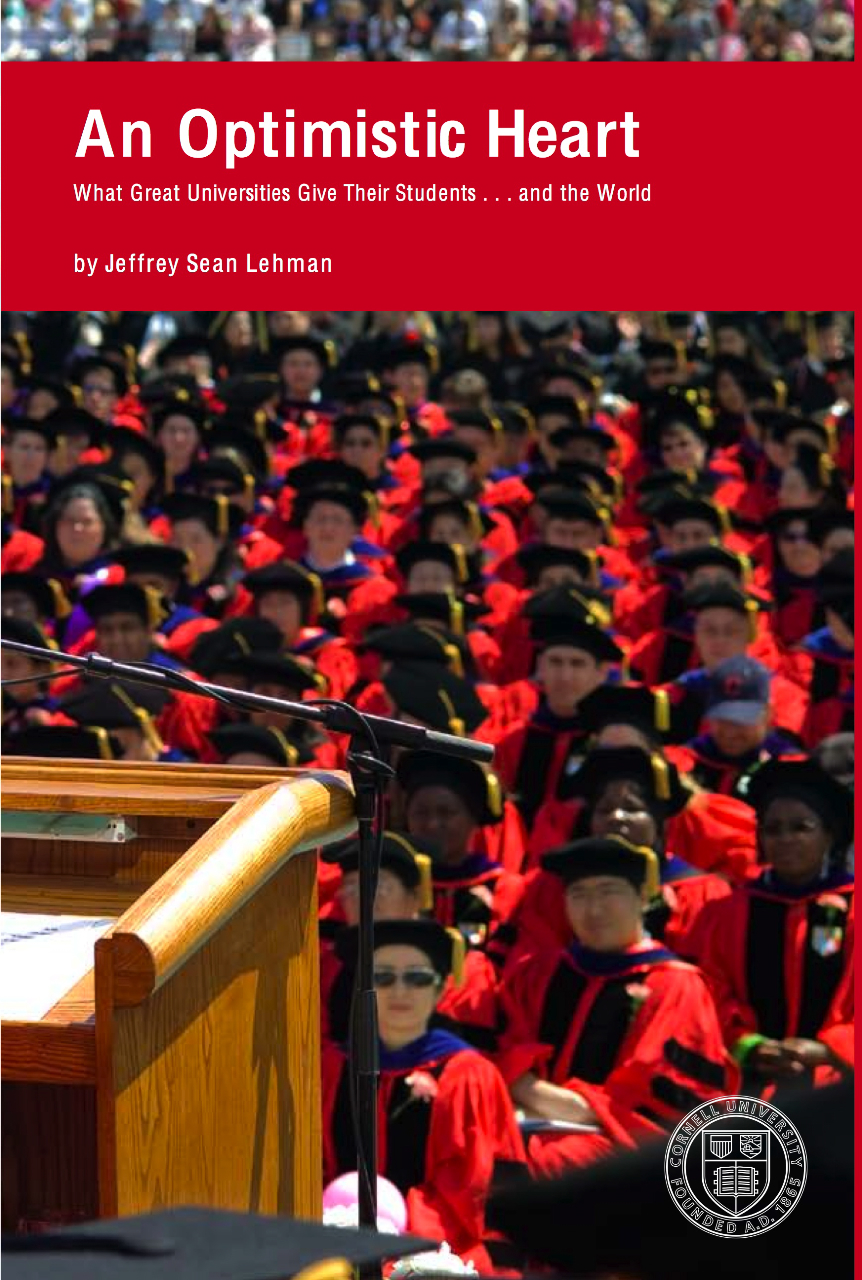

[View streaming video here] [Download PDF version here]
The State of the University
Jeffrey S. Lehman
October 29, 2004
Chairman Meinig. Dear Colleagues. Fellow Cornellians.
When Ezra Cornell was 17 years old, he
began to learn carpentry from a man named Hogaboom on his family’s farm in
DeRuyter, New York. Less than a
year later, Ezra brazenly told his father that he could build a two-story frame
house for the family. And he did. According to the biography of Ezra
Cornell that was written by his son, the new house was “the best residence in
the town of DeRuyter.” And drawing inspiration from that story, Philip Dorf
chose to entitle his biography of Ezra Cornell, The Builder.
If you drive up to DeRuyter today, as I
did last week, you can visit the site of the old house. Only fragments of the foundation
remain. In Morris Bishop’s words,
the house has “moldered away.”
But Ezra Cornell built other, more
enduring structures after that house. When he was 23, he built a 200-foot-long
tunnel through Fall Creek Gorge for Jeremiah Beebe. It still carries water. When he was in his forties, he built a telegraph system
across the Northeast and Midwest that became a cornerstone of Western
Union. It is still a viable way to
send messages or money.
And when Ezra Cornell was in his fifties,
he began to build his enduring legacy, the campus on the hill, the Cornell
University. His successors
remained true to his blueprint, and today his university – our university – is
flourishing. It is a model
university for the world. And its
strength derives from the fact that, in truth, it has had many builders.
The first builders of the university
understood that a set of nineteenth century political, economic, and
technological upheavals had remade the life of this nation. Ezra Cornell. Andrew Dickson White.
Senator Justin Morrill of Vermont, the author of the Land Grant
Act. All of them saw the need for
changes in higher education. The
old institutions of higher learning had been built upon categories that divided
the world into separate compartments – categories of religion, gender, and
race, and categories that separated a classical education from practical
knowledge. Together the first
builders invented a university that challenged those categories in order to
meet the needs of a renewed nation.
A true university, universal in its approach to knowledge, universal in
its approach to people.
In the intervening decades, most of the
world’s finest research universities have come to share Cornell’s founding
commitments to coeducation, to nonsectarianism, to diversity broadly
understood, to a pairing of theory and application, to a principle of equal
respect for classical and practical studies. Yet despite that overall pattern of convergence, Cornell
remains distinctive. There are
other great land grant universities, and there are other great research
universities, but the institution that was founded here has a character and a
purpose all its own. Revolutionary
and beloved, there is only one Cornell.
Our founding commitments are expressed
here with unique clarity, purity, and intensity. Cornell continues to define a precious alloy of reverence
for all forms of insight and passion for active contribution to the welfare of
humanity.
The university has evolved across the
years, developing new ways to fulfill its commitment to serve a rapidly
changing world. In every
generation, new builders have added their own contributions to those of the
founders. And now, with our
sesquicentennial but a decade away, our generation bears the responsibility of
determining how Cornell’s distinctive voice will be heard in this century.
The world has once again been transformed
– politically, economically, and technologically. And those transformations must guide our trajectory in the
years ahead. To renew Cornell, we
must appreciate the challenges and the opportunities that those transformations
present. And like the first
builders we must be prepared to revisit categories that may once have been
useful but today hinder our efforts to teach and to contribute.
Our trajectory begins where we stand
today. It begins with a commitment
to the broadest and deepest possible expression of intellectual
excellence. We inherit a
pluralistic academic culture where many individuals have made transformative
contributions at the heart of long-established intellectual disciplines and
many others have collaborated in unexpected, even unlikely ways, to develop
entirely new approaches to understanding our world.
To build on the commitment we refer to as
“Any person, Any study,” we must refresh two dimensions of our university that
I spoke of during my inaugural last year – the beloved and the revolutionary.
*
* *
How should we renew our Beloved Cornell?
Last year I quoted a member of Cornell’s
first class of students who took pen in hand after one year of classes and
wrote, “We feel that we revere it, we feel that we love it, that it is really
our alma mater.” What would lead
tomorrow’s students to take up their laptops and profess their deep and abiding
love for this university?
The answer is easy to state, but
difficult to achieve. We must be
the university that can best prepare our students for lives of contribution and
meaning. We must be the university
where they are most likely to become voraciously curious, culturally, socially,
and scientifically literate adults.
To be those things, we must draw upon the special resources that are
available only to a university of Cornell’s quality, scale, and breadth.
Everything begins with the faculty. At no time in the history of higher
education has the quality of individual faculty members been more
important. The more collaborative
form of scholarship that prevails in many domains today means that top
professors are, more than ever before, human magnets who attract others of
comparable ability to work with them.
We must remain focused on attracting and retaining a broadly diverse
faculty of extraordinary men and women – the professors whose ideas will shape
our world in the decades to come.
But having assembled such a faculty, we
must ensure that our students are reaping the full benefit of their
presence. Today mere facts are
more readily accessible than ever before; our students look to their professors
less as sources of information and more as sources of guidance on how to
discern truth and understanding.
We must provide our faculty with the technological and pedagogic
resources they need to provide that kind of guidance through their
courses. We must encourage our
students to be active collaborators with the faculty in research and
scholarship. And we must ensure
that every student has the opportunity to find a professor who is also a true
mentor, a role model who can offer meaningful guidance about questions
unrelated to a particular course or research project.
We must therefore continue to expand our
initiatives to reduce the boundaries between faculty and students, both during
the school day and after classes end.
Some of those initiatives, like the cultural activities associated with
the book project, are programmatic.
And some, like the West Campus Residential Initiative, call for us to
build new structures.
And what about the students
themselves? The first builders of
Cornell recognized the importance of establishing an intellectual community of
outstanding students that was not restricted on the basis of gender, religion,
race, or wealth. The boundaries
that separated people into categories no longer determined everything. What mattered most was talent. To be sure, it would be a serious
overstatement to suggest that the artificial boundaries disappeared. But here was a crucial step in the
right direction.
As important as that goal was in the
nineteenth century, it is even more important today. Our students will graduate into a world where boundaries of
race, gender, religion, sexual orientation, social class, and nationality
matter far less than ever before.
In their professional environments they will need to work effectively
with people who are very different from themselves. Before they step out into those environments, they should experience
the benefits of living in a diverse community, enjoying the variety of
perspectives that people bring from different backgrounds, while also
appreciating the overarching commonalities that transcend such differences.
We must continue to take affirmative
steps to promote the meaningful integration of our community along as many
dimensions as possible. We must
ensure that our recruitment of undergraduate and graduate students, faculty and
staff reaches out to the most diverse audience possible. Once at Cornell, all members of our
community should feel welcomed as equal members. And no matter what their personal background might be, they
should also be pressed to take advantage of all aspects of our community’s
diversity, encouraged to reach out across boundaries to meet one another,
challenged to see the world through the eyes of others.
All members of our community should
strive to nurture within ourselves a form of what John Keats called “negative
capability”: a capacity to hold
multiple perspectives in one’s head at the same time “without any irritable
reaching after fact or reason.”
That goal is well served by developing a diverse and actively integrated
community. To enjoy the benefits
of such a community, we must sustain an environment in which our daily lives
are characterized by a constant ebb and flow between people like ourselves and
people who are different.
I would note two special challenges that
we will confront in the coming decade as we maintain our commitment to assemble
at Cornell a diverse and actively integrated community of talent. The first has to do with ensuring
continued access to Cornell for all students, regardless of wealth or
income. The second has to do with
our ongoing emergence as an ever more transnational university.
Maintaining our historic socioeconomic
diversity will require careful coordination of our tuition and financial aid
policies. Even though the market
may be capable of bearing significant tuition increases, we should not be
raising tuition any more than our commitment to world-class education
requires. Tuition increases must
be integrated with a comprehensive system of financial aid – grants, loans, and
work, both government-funded and internally sponsored – that preserves Cornell
as an option for students from low- and middle-income families. We must secure the endowment funds
needed to guarantee need-blind admissions into the future and also to reduce
the amount of self-help required of students from those families.
To be a transnational university we must
recruit and enroll the most talented students in the world. We must expose others around the world
to the research and teaching of Cornell faculty. We must have outstanding faculty who study the histories,
cultures, politics, and economies of every part of the world. Our curriculum must be rich with
offerings about foreign languages and cultures as well as the many languages
and cultures that are found within our nation. We must continue to expand our presence around the globe.
“Presence” can take many forms. Our new campus in Qatar reflects the
most ambitious, exceptional form of presence. The circumstances are unusual where we can develop a new
campus at the level of quality we expect of Cornell, where such a campus can
make an important difference in the world, and where the venture will not
demand so many financial or human resources as to compromise the quality of our
university as a whole.
But we should not content ourselves to
sit back and wait for such special opportunities. Other approaches can extend our presence as well. We should continue to support
faculty-to-faculty collaborations across national boundaries, just as we always
have. And we should establish
meaningful university-level partnerships with peer foreign institutions,
committing ourselves to key relationships that will fortify our teaching,
research, and outreach missions.
I believe that such intensive
partnerships should be initiated judiciously, in order that they may be both
meaningful and sustainable. To
maximize their impact, we should begin by training our attention on countries
that are certain to hold strategic significance for Cornell over the next few
decades. Within those countries,
we should look only to our peers, to the very finest institutions of higher
education and research. And among
those, we should only consider those institutions where there is a clear
mutuality of interest and benefit.
A week from now, the Deans of Engineering
and Arts and Sciences will be traveling with me to China to take the next steps
in forging such alliances with Tsinghua University and Peking University. These new partnerships meet all of the
criteria that I have set forth above.
I am confident that we can build other such alliances in the years
ahead.
To be sure, our students’ experience of
Cornell depends on more than just our faculty, and more than just their
relationships with their fellow students.
Their love for the university derives in part from the effectiveness and
responsiveness of the many institutional and human structures that, along with
the special beauty of the campus and surrounding environs, define the canvas
upon which they paint their intellectual, cultural, and social
development. That canvas comprises
everything from intercollegiate and recreational athletics to the dining halls,
from fraternity and sorority life to the CIT Help Desk, from the Schwartz
Center for the Performing Arts to our career services offices.
Extracurricular activities provide
opportunities for our students to develop many skills that will determine their
future successes in life. Student
services provide support that may help determine their success at Cornell. In each of these domains, the quality
of our support depends upon our staff as well as our faculty. Our commitment as an institution must
be to ensure that all our students have access to a complete university
experience, one that will help them to realize their full potential as adults.
That kind of experience will mean
something different for each and every student. But I do hope that for all our students, it will
include a measure of civic engagement.
Over the course of the past two months, we have seen on this campus a
model of what student civic engagement can be. A group of students whose views span the political and
ideological spectrum joined together to create a project called the Mock
Election project. We supported
that project, but all of the leadership and 98% of the work effort came from
the students themselves. They sponsored nearly a score of events since the
beginning of the semester, including a debate among the three candidates for
the U.S. Senate from New York, a debate between the editors of the National
Review and the Nation, and a debate about outsourcing between the president of
the U.S. Chamber of Commerce and the secretary/treasurer of the AFL-CIO. Thousands and thousands of students
attended the various events. And
at the end, over 6000 students cast electronic ballots in a mock election.
When we do it right, our students show
this kind of constructive initiative.
They are creative. They
engage with the civic issues of the day.
They learn, their lives are full, and their love for Cornell is deep.
*
* *
How should we renew our Revolutionary
Cornell?
The first builders of the university created
a new way to meet the needs of an industrial society. As heirs to that tradition, we must consider the needs of
contemporary society. We must
consider Cornell’s unique capacity to understand and address those needs. The first builders refused to define
the university’s limits by reference to categories that once were taken for
granted. And we must ensure that
the extent of our response is not limited by the legacy of categories inherited
from the past.
This morning I would like to describe
three great challenges facing humanity that present exciting opportunities for
Cornell. These are domains of
fundamental worldwide significance.
In each case, they call for contributions from a broad range of
intellectual vantage points. Each
demands searching reflection using the tools of the humanist. Each calls for creative and rigorous
social scientific analysis. Each
has essential scientific and technical dimensions. Indeed, each requires strength across the full range of
disciplines where this university excels, and each will benefit from the spirit
of multidisciplinary collaboration that is our hallmark. These are areas where the world needs
Cornell, and where our founders would expect Cornell to respond to that need.
The first challenge concerns life in the
age of the genome. All of us who
know Cornell are aware of the genomics revolution. The realization that a single DNA vocabulary describes all
forms of life, from viruses to people, has inaugurated a new era in biological
and biomedical research. The work
requires a fusion of traditional biological research across plant and animal
species with research in chemistry, computer science, engineering, medicine,
and physics – all fields where Cornell exerts a powerful presence. In this era we can expect to understand
the fundamental mechanisms of life in new ways, and we can expect that
knowledge to fuel diagnostic and therapeutic innovations that will further
lengthen the average human lifespan and significantly improve the quality of
each of our lives.
The effects of such breakthroughs could
be as significant to our understanding of ourselves as were the Copernican and
Darwinian revolutions. They have
the capacity, as those revolutions did, to change our conception of our place
in the universe, our relationships with other species, our relationships with
machines, and our relationships with one another. We could face a new set of
questions about what it means to be alive and what it means to be human. Questions about how much of our lives
should be spent in the paid workforce and about the relationships among
generations in society. Everywhere
in a university that people discuss the meaning of life, the terms of
discussion could shift.
We should expect these themes to be reflected in our cultures and in our
political institutions. We have
already seen different reactions in different societies to, for example, the
subject of genetically modified foods.
In the years to come we will need an ever more nuanced understanding of
such cultural differences. Once again, Cornell is unusually well prepared to
bring the tools of different disciplines to bear on the analysis of the
cultural, social, and economic effects of these developments.
By virtue of its unique breadth and
depth, and because of its strong tradition of cross-disciplinary collaboration,
Cornell can and should lead the world in this domain. Several critical initiatives are already underway. The New Life Science Initiative has
been working with both internal and external advisory councils to draw together
the community of researchers from all disciplines on both our Ithaca campus and
at the Weill Medical College in New York City, to give new strategic direction
to their research. We have begun to hold joint conferences for scientists from
the two campuses, to nurture collaborations in fields such as biomedical
engineering and nanobiotechnology.
Through the Bridging the Rift Initiative
we have begun work on a project to create a prototype for the Library of Life,
through which digital information concerning all of Earth’s life forms will be
organized and linked in a system that is susceptible to new forms of data
mining and analysis. The goal is
not only to amass information but also to develop software that will permit new
forms of interaction among professional researchers everywhere and anyone else
who is curious, so that the building of knowledge and the education of citizens
are ever more open and participatory activities.
These projects, and others of the same
caliber, will ensure Cornell's leadership as the world faces the possibilities
and responsibilities of the genomic age.
A second great challenge concerns wisdom
in the age of digital information.
The revolutions in computing and information science have affected every
form of human activity. From
medicine to the movies, architecture to sociology, computing and information
science have transformed both how we live and how we study how we live.
Importantly, Cornell has led both in the
development of computing and information science and in its propagation
throughout the university. Thanks
to the development of our Faculty of Computing and Information Science, three
different undergraduate colleges offer majors in computer science, computational
biology, and/or information science, and all seven undergraduate colleges offer
information science minors. We have a newly established graduate field of
Information Science and a corresponding Ph.D. program. Thanks to the strength of our library
we have already begun to lead the way in the development of digital archives,
innovative search tools, and online journals. More and more, Cornell is being
recognized as a farsighted leader in the information revolution.
And yet it is clear that the developments
that will come in the next few decades will dwarf in significance those of the
past few. Theoreticians and
engineers are proposing new theories of how the brain works that could lead to
the development of truly intelligent machines. Even if such projects fail, the next generations of our
current, relatively unintelligent machines will enable unprecedented amounts of
information to be collected, stored, and processed at astonishing speed.
It is not at all evident what
consequences these technological developments will hold for the way humans
live. Today, virtually no
possibility – neither the utopian nor the dystopian – can be dismissed out of
hand. Where we land will depend in
significant part on the ability of humans to show wisdom in the application of
next-generation information technologies.
And that ability depends on a broad and deep education.
Cornell can and should shape this
future. The project of
transforming mere information into human-centered wisdom can benefit from the
insights of disciplines across our university. But as currently configured we have neither the human nor
physical resources to maintain our leadership role for an entire decade. We must add greater faculty strength in
the welter of disciplines that touch and concern these issues. We must build a new facility in which
interdisciplinary research and teaching is facilitated. And we must highlight the work of
scholars whose research focuses on the effects of technological change, its
impact on the nature of work, and the nature of communication and community, drawing
here, too, on our great strengths in several colleges.
A third challenge concerns sustainability
in the age of development.
Technological progress and economic development have brought
unprecedented levels of material comfort to our generation of participants in
the global economy. At the same
time, those phenomena have raised a series of new issues that tend to be
grouped under the broad heading of “sustainability.”
For a variety of reasons, the current
mode of life on Earth cannot be sustained indefinitely. Our technologies consume scarce
resources that would ultimately be exhausted. They damage ecosystems in ways that would ultimately prove
inimical to human life. They rely
on political or economic programs that are likely to collapse under the
pressure of demographic change. And as a species, human beings have not yet
reached a level of understanding and tolerance that will allow the peaceful
co-existence of communities with very real differences.
Sustainability problems have a
characteristic structure. They
require some form of adaptive innovation, some form of substitute approach, to
be developed and implemented before time runs out. They require a scheme of gradual transition – not so quick
as to be destabilizing, but not so slow as to be inadequate to the challenge
presented. And in the long run
they can be solved only with approaches that are economically viable.
Today almost every domain of human
economic and political activity presents one or another sustainability
problem. Because of our
university’s extraordinary breadth, we are bringing tremendous research effort
to bear on different sustainability issues. Across our colleges, faculty members are working on those
areas often associated with the challenge of sustainability – environmental
science, environmental remediation, energy production, and ecology more
generally – and other faculty members are studying the economic, political, and
cultural effects of globalization, as well as current trends towards increasing
economic inequality. Across the colleges and disciplines, and in some of our
cherished special units like the Lab of Ornithology, Shoals Marine Lab, and the
Plantations, we are promoting a deeper appreciation of nature that can guide us
in our work. And in our daily activities
on campus, we continue our efforts to bring relevant knowledge to bear on the
decisions we make regarding our own practices.
The list of what we are doing now is long
– but we must do substantially more. We must draw these disparate efforts
together into an integrated whole.
We must develop structures of collaboration so that insights in one
domain might stimulate correlative insights in another. And as we develop a mature
understanding of the different dimensions of sustainability, we must employ our
various extension resources to disseminate our findings to the public.
In a biography of Liberty Hyde Bailey
published in 1956, he is quoted as saying:
“It is a marvelous planet on which we
ride. It is a great privilege to
live thereon, to partake in the journey, and to experience its goodness. We may cooperate rather than
rebel. We should try to find the
meanings rather than to be satisfied only with the spectacles.”
Three great challenges for our
world. Three great opportunities
for our university. For each of
these challenges, I have asked Provost Biddy Martin to work with deans and
faculty members to develop a long-range strategic plan. Each of these plans will structure the
support and integration of our many existing efforts. Each will identify aspects that need further
development. And each will
consider how we can best ensure that Cornell’s contributions are uniquely
significant and meaningful.
*
* *
Cornell has had many builders.
The founders of Cornell crafted the plan
for a university that would become a world treasure. Other builders stepped forward to turn that plan into a
reality. They were professors like
Carl Becker and Alice Cook. They
were deans like Martha Van Rensselaer and Howard Bagnall Meek. They were students like Hu Shih and
E.B. White. They were benefactors
like Jennie McGraw, and Harold and Ruth Uris.
Now it is our turn.
Over the course of the next decade, let
us renew our beloved Cornell. Let
us ensure that its faculty, its staff, its programs, and its students together
constitute a university worthy of our students’ love.
And let us renew our revolutionary
Cornell. Let us insure that the
intellectual breadth and depth of our university is brought to bear on the
fundamental challenges of our time.
Life. Wisdom. Sustainability.
The result will be a truly transnational
university. A university with
worldwide presence. A university
whose graduates become leaders around the globe. A university whose research has universal impact.
There is much work to be done. It is both gratifying and exciting for
me to know that we are building Cornell together.
Thank you.
